
Richfield City Directory Collections
Richfield history is spread across several shelves rather than one uninterrupted local run. Hennepin County Library provides digitized city-directory search guidance and a viewer for scanned directories. The Minnesota Historical Society, or MNHS, holds the deeper telephone-directory collection. School yearbooks, historic maps, and local newspaper files add context when a name appears only briefly or an address has changed form. Treat every volume as an edition with its own limits, not as a complete list of everyone in the city.
| Collection | Years | Where Held | Access |
|---|---|---|---|
| Hennepin digitized city directories | Individual online years not stated in the official tips | Hennepin County Library viewer | Search scanned pages with the library's documented search rules |
| Richfield telephone directories | 1926 to 1992, irregular; print and fiche material through 2005 | MNHS Gale Family Library finding aid | Use the finding aid for volume, shelf, and fiche detail |
| Richfield school yearbooks | Runs vary by school, from 1949 through 2023 | Hennepin County Library, with some digital volumes | Consult holdings by school and year |
| Richfield Historical Society local images | 1886 to 1979 search results | Minnesota Digital Library | Search maps, aerials, atlases, and photographs |
The documented telephone run is irregular. Yellow-page entries appear for 1926 through 1928, regular books resume for 1941 through 1945, and later regular and yellow volumes appear in changing combinations. The finding aid identifies later print and fiche holdings, but it does not support a claim of seamless coverage. Keep a gap in the timeline as a gap, then test a directory viewer, newspaper, map, or census source for that period.
Search Richfield City Directory Scans
Hennepin County Library's viewer uses exact-text search. It is not case-sensitive, accepts * and ? wildcards except as the first character, and does not use Boolean operators. Quotation marks are unnecessary. Deselecting other cities can narrow a result set when a surname or street appears around the county. These rules matter most for a short surname, an abbreviated given name, or a street shared with Minneapolis.
Search an address exactly as it was printed, not only as it appears today. Try South and S, St and Ave, plus a spelled-out numbered street where useful. Historic directories can also retain older numbering or a suburb style that differs from the modern form. A directory result supports a historical listing for that edition; it does not settle a current address or prove a complete household.
Richfield Telephone Directory Holdings
MNHS describes a Hennepin County telephone-directory collection dated from 1889 onward, with about 1,342 volumes and 234 microfiche sets. Its Richfield heading identifies both white and yellow books. White pages can pair residential or business numbers with street addresses, while yellow pages organize businesses. For a household trail, a telephone book can bridge an interval between directory editions, but publication lag, unlisted numbers, and missing volumes still matter.
The MNHS telephone-directory finding aid identifies Richfield's regular, yellow-page, print, and fiche holdings.
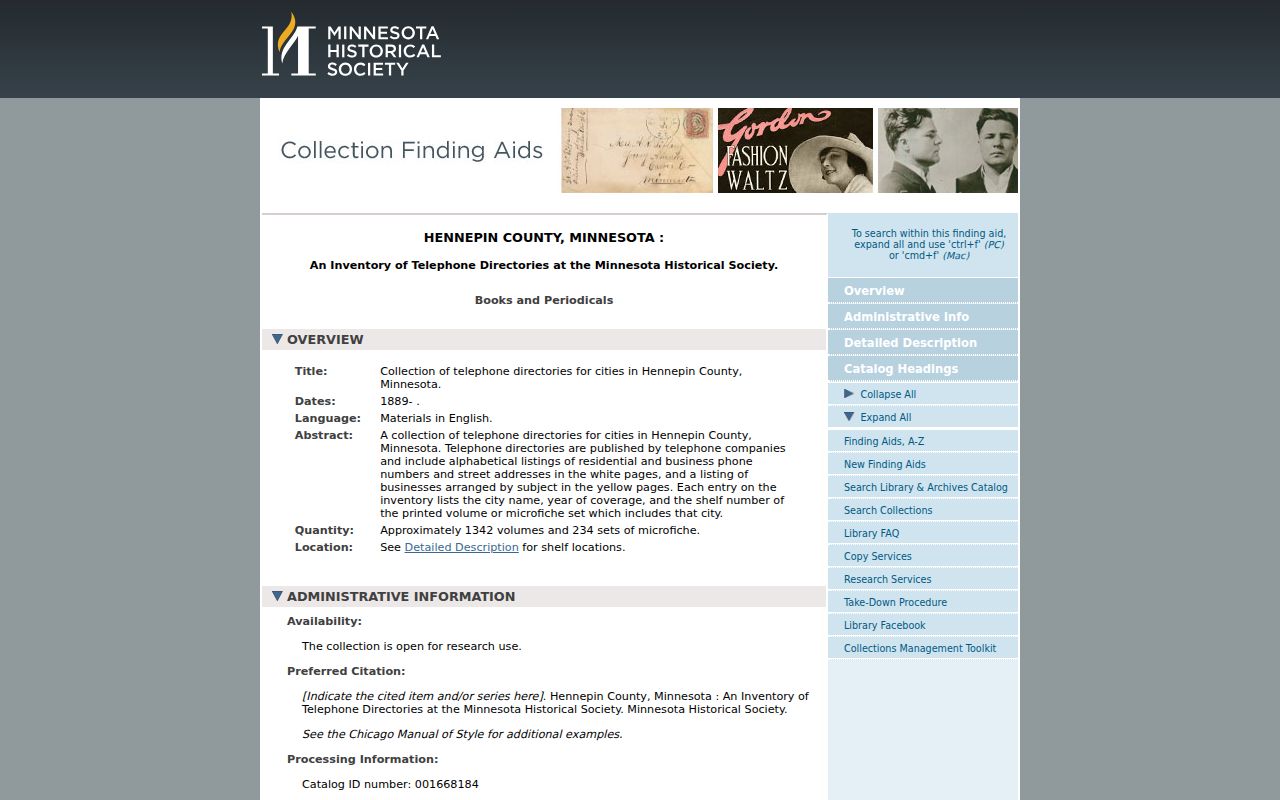
Use the finding aid to choose a specific year before traveling or requesting help, especially where a regular volume and a yellow volume differ.
Note: A telephone-directory miss may reflect the surviving format or a publication gap, so test the adjacent year before drawing a conclusion.
Read a Richfield City Directory Entry
A scanned entry is a compact historical record. The official library guidance describes the parts that may appear, but no live Richfield entry was captured during the research pass. Read every mark in its edition context and record the page or scan with the transcription. A person's listing may contain fewer details than a business listing, and early volumes can treat women and family relationships differently from later volumes.
| Name form | Surname, given name, initials, or an abbreviation such as Robt, Wm, Chas, or Geo. |
|---|---|
| Family notation | A spouse in parentheses, a widow notation, a separate listing, or no separate listing in earlier editions. |
| Work or business | An occupation, employer, or business connection when the edition includes it. |
| Street line | The printed house number and street spelling, sometimes joined to a household marker. |
| Household mark | h may mean homeowner or householder in later runs; r may mark a roomer listing. |
- Criss-cross directory
- An address-first arrangement that lets a researcher begin with a printed street address and identify the listed occupant or householder.
- Householder index
- A name listing centered on the person or household representative, rather than a run of addresses in street order.
- Abbreviation key
- The volume's explanation of shortened words and marks. Check it before treating a letter beside an address as a fact about ownership.
Richfield Yearbook Directory Companions
Yearbooks can help distinguish people who share a name without turning a historical search into a current-address inquiry. Hennepin County Library lists Richfield High School's Aurean at 7001 Harriet Avenue South in print for 1957 to 1993, selected later years through 2021, and some digitized volumes. The library also identifies Richfield Junior High, East Junior High, West Junior High, Watershed High School, and Academy of Holy Angels holdings with their own date ranges.
The Hennepin County Library yearbook holdings list the Richfield schools and available years.
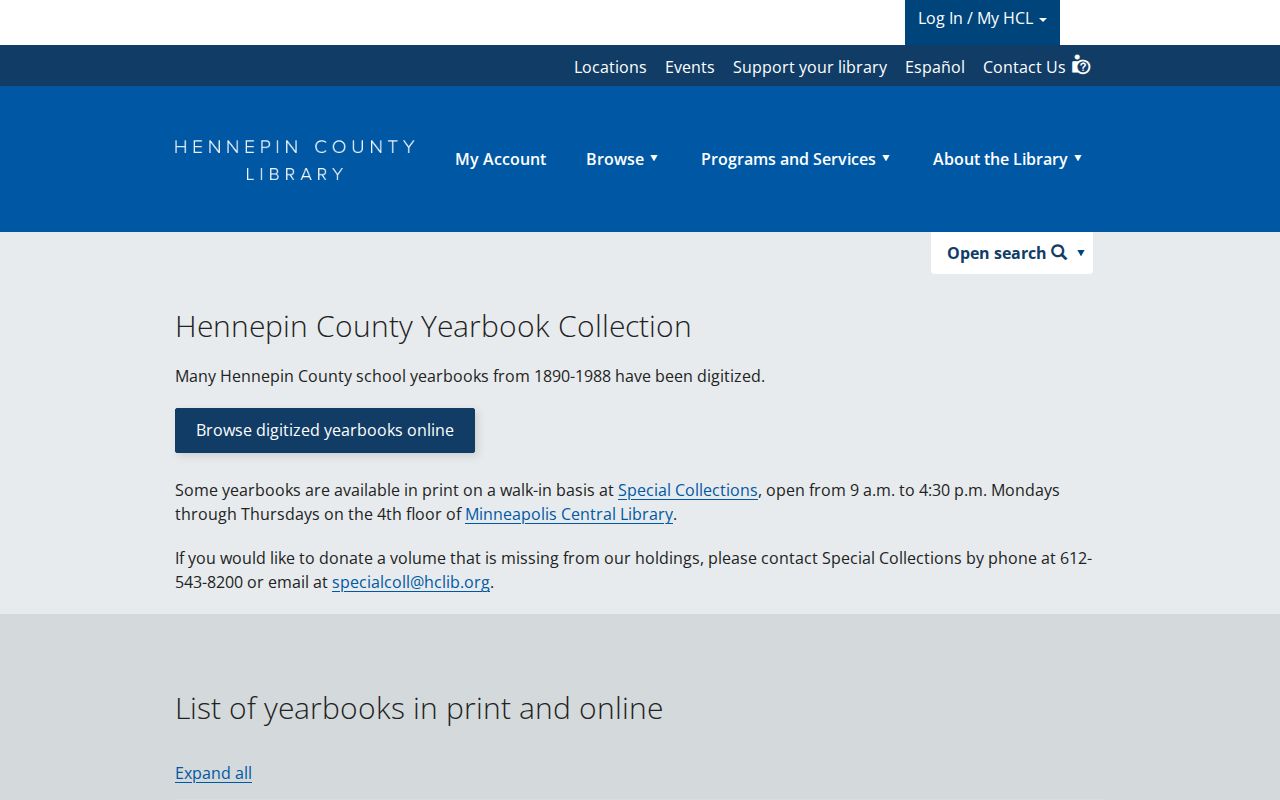
A class label, activity, or photograph can support a school-era connection before a directory, newspaper notice, or public record is compared.
Richfield Directories Beside Historic Maps
Place the printed address beside a map before deciding that two similar labels refer to different places. The Richfield Historical Society's Minnesota Digital Library collection has results dated 1886 through 1979, including aerials, atlases, and maps. Its circa-1940 atlas has an index and 23 pages, but maps 1 through 11 for territory annexed to Minneapolis in 1927 are missing. Maps 12 through 32 remain.
That boundary history explains why an older directory or image can carry a Minneapolis label for ground once associated with Richfield. The 1941 village atlas, revised 1941 through 1943 material, and aerial coverage provide location context. Keep the original directory spelling, the map sheet, and the edition date together instead of silently converting every older label to the modern city name.
Note: A historic Richfield result filed under Minneapolis can be a boundary-era clue, especially when the address lies in the 1927 annexation area.
Richfield Directory News and Oral History
When a listing has no obvious next edition, local news can test a name, street, school, business, or civic-group connection. MNHS identifies the Richfield edition of the Sun Current as a weekly publication from August 1984 through November 2018, later merged with the Bloomington edition. The Digital Newspaper Hub spans millions of pages from 1849 to today, although copyright restrictions often keep post-1977 content at the Gale Family Library. Search name and address variants, then keep the newspaper date separate from the date of the directory volume.
MNHS also holds a Richfield postwar oral-history collection created in 2007 with 47 sound cassettes and 24 transcripts. Interviews include civic leaders and people connected with schools, water, airport growth, New Ford Town, and local organizations. An oral-history mention can provide context or another search term, but it should not replace a directory page, map, or recorded document as address evidence.
The Richfield Historical Society is another local handoff when a map caption or old city label needs interpretation. It operates the 1852 Bartholomew House at 6901 Lyndale Avenue S and is open Wednesdays and Saturdays from noon to 4:00. Its Minnesota Digital Library material preserves the city's shift from rural township and market farming to an early suburb. Use that setting to explain a historic place name, then return to the dated directory listing for the person-and-address evidence.
Trace Richfield City Directory Households
A forward name search and a reverse address search answer different questions. Start with the earliest verified name or printed address, then use adjacent editions to test whether the street, spouse notation, and work information remain consistent. The city directories show historical listings, while the previous-residents search follows a single address backward through deeds and parcel records.
- Search the surname and useful abbreviations in one directory edition, then record the full printed address and page.
- Check the same name in the next available edition and note a move, changed spouse notation, or changed work information.
- Run the historic address through the criss-cross or reverse arrangement, including an attached
horrwhere the viewer requires it. - Pair the trail with the released federal census years that fit the time period, using the census as a household anchor rather than a current list.
- Use telephone books for gaps, then test an apparent move or disappearance against yearbooks, maps, newspapers, probate, or deeds.
A missing entry can mean a move, an unlisted number, an incomplete volume, a different name form, or a change in what the publisher printed. It does not establish a death or a move by itself. The Sun Current Richfield edition, published weekly from August 1984 through November 2018, can offer local notices, though post-1977 material is often available only at the Gale Family Library because of copyright limits.
Note: Keep the directory page, edition date, and next-source date together so a household trail can be checked without relying on memory.
Richfield Directory Timeline and Boundaries
Richfield's record geography changed before the modern city footprint settled. Hennepin County was established in 1852, town meetings began in 1858, and the city incorporated in 1908. The earlier territory was much larger, and a 1927 annexation to Minneapolis affects where an older directory or atlas may place an address. Those milestones help choose a county, township, village, Richfield, or Minneapolis search label.
- 1852: Hennepin County was established, creating an early county-record layer.
- 1858: Richfield town meetings began, so early local references may use township terms.
- 1908: Richfield incorporated as a city.
- 1927: Territory was annexed to Minneapolis, producing a lasting label and atlas-coverage complication.
- 1926 to 2005: The documented Richfield telephone holdings begin with yellow pages and continue in irregular regular, yellow, print, and fiche formats.
For an older family trail, MNHS also holds Hennepin civil-court case files from 1858 to about 1934 and naturalization materials on microfilm from the 1850s through the 1950s. Those archive routes can add context when a directory gives only a name and address. They should be treated as separate record groups, not as a substitute for the directory volume itself.